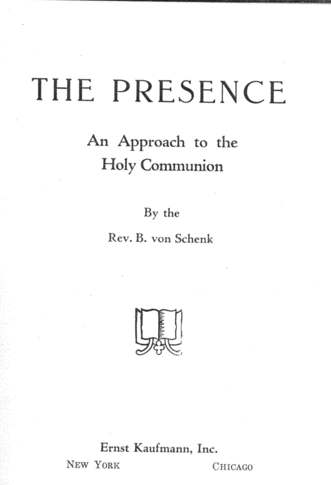
The Presence, by Berthold von Schenk

This book, listed above, isa rather interesting book written if I recall in 1945.  Berthold von Shenk is often cited and considered one of the fathers of the liturgical movement in the LCMS.  He is without a doubt one of the more interesting characters, that’s for sure.   Rev. Paul Sauer did a nice job with a paper on von Schenk at the CTS Symposium a couple years ago.

Anyway, one of the benefits of my little corner of the world is that I have a wicked awesome coper/scanner thing, which allows me to scan big files into PDF format easily.  I have done so with this book.

So my question is, are any of you interested in having this book run through OCR so that it would be searchable?  Let me know.  Either way, I will be posting it shortly.

-LL


thepresencecover.jpg


Books for Sale (Patristics, Eastern Orthodoxy & Exegetics mostly)

I am helping a friend sell a bunch of books.   HERE IS A PDF OF THE BOOKS AVAILABLE.  Some of the titles for the books include:


  • 11. St. Gregory the Great, Pastoral Care
  • Basics of Biblical Greek Grammar
  • Biblical Hebrew Vocabulary Cards
  • The Book of Isaiah, Chapters 1-39
  • The Byzantine Commonwealth: Eastern Europe, 500-1453
  • The Byzantine Legacy in the Orthodox Church
  • Byzantium & the Slavs
  • C. S. Lewis’ Letters to Children
  • Christ in Eastern Christian Thought
  • The Christian East and the Rise of the Papacy: The Church 1071-1453 A.D
  • The Christian Theology Reader
  • Chronological and Background Charts of the Old Testament
  • The Church of the Ancient Councils: The Disciplinary Work of the First Four Ecumenical Councils
  • A Concise Exegetical Grammar of New Testament Greek
  • The Conservative Reformation and Its Theology
  • Cyril and Methodius of Thessalonica: The Acculturation of the Slavs
  • The Desert a City: An Introduction to the Study of Egyptian and Palestian Monasticism Under the Christian Empire
  • A Dictionary of Early Christian Beliefs
  • The Didache: A Commentary
  • A Documentary History of Religion in America (2 vols.)
  • The Early Church
  • Early Church and State
  • The Early Liturgy
  • The Ecclesiastical Text: Text Criticism, Biblical Authority & the Popular Mind
  • Elizabeth: Grand Duchess of Russia
  • From Nicaea to Chalcedon: A Guide to the Literature and Its Background
  • God & Man in Music
  • A Grammar for Biblical Hebrew
  • Gregory of Nyssa: The Life of Moses
  • Historical Theology: An Introduction to the History of Christian Thought
  • A History of Christian Thought: Volume 1: From the Beginnings to the Council of Chalcedon
  • A History of Christian Thought: Volume 2: From Augustine to the Eve of the Reformation
  • A History of Israelite Religion in the Old Testament Period
  • Homiletic Moves and Structures
  • The Institutes
  • Isaiah II
  • Jesus Through the Centuries: His Place in the History of Culture
  • Josephus: The Complete Works
  • The Koran
  • The Later Christian Fathers: A Selection from the Writings of the Fathers from St. Cyril of Jerusalem to St. Leo the Great
  • Latin Can be Fun
  • Lexical Aids for Students of New Testament Greek
  • Licht auf dem Weg Band II.
  • The life of Christ
  • Mark: A New Translation with Introduction and Commentary
  • Maximus Confessor: Selected Writings
  • Morphology of Biblical Greek, The
  • Mystery Of The Church
  • The New Testament: An Orthodox Perspective
  • On Ascetical Life (Popular Patristics Ser.)
  • On Christian Teaching
  • On Searching the Scriptures — Your Own or Someone Else’s: A Reader’s Guide to Sacred Writings and Methods of Studying Them
  • On the Divine Images: Three Apologies Against Those Who Attack the Holy Images
  • On the Incarnation: De Incarnatione Verbi Dei
  • On the Soul and the Resurrection: St Gregory of Nyssa
  • On Wealth and Poverty
  • A Practical Grammar for Classical Hebrew
  • Proper Distinction Between Law and Gospel
  • Pseudo Dionysius: The Complete Works
  • Rome, Constantinople, Moscow: Historical and Theological Studies
  • The Septuagint with Apocrypha: Greek and English
  • St John Chrysostom: Six Books on the Priesthood
  • St. Basil the Great on the Holy Spirit
  • St. Cyril of Jerusalem’s Lectures on the Christian Sacraments: The Procatechesis and the Five Mystagogical Catecheses
  • St. Innocent: Apostle to America
  • ST.JUSTIN MARTYR:FIRST+SECOND APOLOGIES
  • The Study of Liturgy
  • Understanding the Nicene Creed,
  • What Luther Says: A Practical In-Home Anthology for the Active Christian


If you are interested in any of these books, or any combination thereof, please contact me in the comments on the blog or follow the directions in the PDF file.  You can make me an offer on any book if you think the asking price isn’t right.  Thanks!

-LL


On Calls in the LCMS Today

NewImage.jpg

I’ve been thinking a lot lately about the situation of pastoral calls in the United States today.  For those who do not know, this past week was Call Week at both of our LCMS seminaries.  The LCMS Joint Seminary Fund recently put out their little PDF file listing where everyone is going, if you’re interested (with some tragic omissions).  It is a time of excitement, anxiety, joy, fear, and about every other emotion you could imagine.  Between serving as a student and also serving as an admission counselor for several years at Concordia Theological Seminary, I’ve been to my fair share of call services.  They are one big bottle of crazy wrapped up in about two hours (or less, depending on who’s preaching).

But this past week was not a week of happiness at my alma mater.  Twenty two men from this year’s class did not receive calls, and I believe eight men at Concordia Seminary.  The sort of standard fare reasons for this are fairly predictable.  I have heard the following, and I’m sure there are more:

  • Economy.  Congregations simply can’t afford to call pastors.
  • Congregations requesting graduates from a specific seminary.
  • A vast left-wing conspiracy against confessional students at both seminaries.
  • The SMP programs, DELTO programs, and various alternate route programs are drying up the number of traditional calls in the LCMS.
  • The graduates aren’t qualified or don’t have the right personality/disposition to serve in the Holy Ministry.

Our thoughts and prayers go out to these soon-to-be brothers in office that are awaiting calls.

Here are a few things that I pray that we as a synod consider as we try to wrestle with this sadness, especially as we move into the 2010 LCMS Synodical Convention:

Repent.  We as a church body must repent for our failure to place these men (and their families, for they do go together).  They aren’t martyrs like our forefathers in the early church.  But they have desired a noble task (1 Tim. 3:1), and we as a church body have encouraged them in this endeavor.   While I suppose there were no guarantees that they would be placed, they have acted in good faith, and so should we.

Explain everything in the kindest way.  It is easy and oh so tempting to ascribe motivations to people in power, to students, to congregations, and to just about anyone.  There may be culpability here, but it must be based on fact, not innuendo and what really comes down to either gossip or slander.

Search the Scriptures.  Our Lord has said:  “The harvest is plentiful, but the laborers are few. Therefore pray earnestly to the Lord of the harvest to send out laborers into his harvest.” (Luke 10:2 ESV)  This is the Word from our Lord.  It is true.  The need is there.  We have a world of hurting sinners in need of the healing balm of the Gospel.  If we as a synod cannot place these men, it is more of a sign that we are not aligned with what God wants of His church than anything else. How have we allowed our priorities as a church body to be derailed so that the preaching of the Gospel is not the point?

Pray.  This again may be obvious, but it must be said.  Pray in thanksgiving to God for His gift of the Holy Ministry of the Gospel.  Pray in repentance, that our Lord may forgive our arrogance, our selfishness and our need to make everything fit and be controlled in our own way.  Pray that God would provide for these men and their families, as they are now in synodical limbo.   And pray that God would do His work of placing these men where they are needed so that His Word may go forth to the joy and salvation of all.

Act. These men and their families (about 30 in all between the two seminaries) have real needs, with debt, families to provide for, and ongoing preparations for God’s work for them.  How can we as a synod, as congregations and as individuals care for and serve them while this is sorted out?

What am I missing, friends?

-LL (aka Pr. Todd Peperkorn)


PS Rev. Matthew Harrison also recently had a wonderful sermon offering comfort especially to those who have not received calls.  I would urge you to read it and check it out.


Cantate 2010

Audio of the Sermon

Cantate 2010 (May 2, 2010)

““I still have many things to say to you, but you cannot bear them now. When the Spirit of truth comes, he will guide you into all the truth,” (John 16:12–13 ESV)

Introduction

Have you ever had one of those cases where you walked into a room and five people tried to talk to you all at once?  Frustrating, isn’t it?  Each person has their own demands, their own questions, and their own important things they want to say to you.  We call that “breakfast” at our house.  It’s hard to concentrate when this happens, because you don’t know which voice to listen to, or how to make it happen.

This is obvious when we talk about things at work or at school or at home or on the news.  If you have too many distractions, too many voices trying to speak to you at once, you can’t focus, you can’t listen, and perhaps even more of a problem, you can’t sift out the truth from the lies, you can’t prioritize what really matters.  It all just becomes a big jumbled mess.

Jesus in our text this morning wants to teach you about listening to Him, and not allowing the voices of this world to distract you and draw you away from the Way, the Truth and the Life.  Listen in on what He has to say.

Question One: What are the voices distracting you?

So the first question is, what are the voices that seek to distract you and keep you from hearing the truth of His Word and the resurrection?  You probably know the answer to that better than I do.  The voices of this world are tempting, deceiving, and are very effective at getting us to listen to their siren call.  We can summarize these voices as two kinds, inside and outside voices.

Outside

When we talk about what voices are we listening to, it would be easy to sort of go through the litany of moral ills of our day.  Television, computers, the internet, text messaging, games, friends, sports, recreation, work, play, frankly anything.  None of these temptations, these voices from the world around us, none of these things are evil in and of themselves.  Far from it!  The earth is the Lord’s and all the fullness thereof.  It would be pretty tough to argue that everything in God’s world is evil.  It just isn’t true.

But that draws us into one of the most important teachings about the world and about Satan and sin.  When God made the world, He finished all that he had made and said that it was very good.  That includes Adam and Eve, and the whole of His creation.  But when sin entered into the world, things changed.  Satan in his evil designs tries to take what is good and right from God, and twist it to His own desires and needs.

Think about your own life about how the good things in your life are used by Satan to twist things around, to mess things up and make them at odds with God’s wonderful purposes for you in Christ.  How does Satan use these things in your life?  Only you can really answer that question.  I encourage you to ask them of yourself.

Sometimes these voices from outside are loud.  Sometimes they are so overpowering that it is hard to imagine there even IS any other voice to listen to that is better or more important.  Amazingly enough, though, these aren’t the most tempting or overpowering voices in your life.

Inside

For most of us, the greatest temptations to fall away from the voice of the Good Shepherd lie not from the outside, but from the inside.  No one is better than I am at talking myself into sin.  Pride, despair, desire, arrogance, envy, sloth, malice, who even knows where to begin?  Yet they are all there, right inside of you and me.  I don’t have to look outside to find the problem.  We have met the enemy, and he is us.  Jesus Himself said that it is not what comes from the outside that defiles the body, but from what is inside that makes us unclean.  He’s talking about you and I here, and no one else.

Question Two: So this leads us into question number two for the day, why do you need guiding into the Truth?

Because of all of these voices within and without, your internal compass is off.  You don’t love God with your whole heart and mind, and you don’t love your neighbor as your self.  By nature, you listen to all the wrong voices.  In fact, our listening to all of these disparate voices means that when the still, small voice of His Word shines forth, so often we miss it entirely.  Pilate asked Jesus at His trial, “What is truth?”  It is hard to see the diamond in the midst of so many other shiny rocks sometimes.

Face it, we are deaf to hear God’s Word and are lousy at prioritizing the important from the unimportant in our lives.  This is especially true when it comes to hearing of God’s blessings for you and I.  The conscience is of some benefit, but it won’t lead us into the truth of God’s forgiveness in Christ.

Question Three: How does the Holy Spirit guide you?

If hearing the voice of the Good Shepherd is so hard with all of these voices swirling around how, how does it actually happen?  How can you actually hear and trust that God will do what he promises?  How can you know and be certain that all of these other false voices won’t have their way with you?

The answer lies in the character of God Himself, and of how He works.  First of all, we are in Eastertide here.  Our God is one who keeps His promises.  And He has many great and mighty promises that He makes for you.  And one of those Resurrection promises which Jesus makes for you is that the Spirit of truth comes, and that He is the one who guides you into all truth.

Truth is not something that you discover for yourself.  This is the great fallacy of our age.  Modern thought teaches that truth is something you find, or even something you create all on your own.  But that is the lie.

Truth is a gift, and God is the giver of all Truth.  So the truth of God’s love for you in Jesus Christ comes to you by His Word and Spirit.  That is what God promises to you. That is the truth.  That is reality.  The Holy Spirit is the one who convicts of you sin.  The Holy Spirit is the one who teaches you of God’s love in Jesus Christ.  The Holy Spirit is the one who does God’s great and mighty work of teaching you that you are free from sin.

Conclusion

The voices of this age are real and tempting, but the voice of God, given to you by His Spirit through the Word, is powerful, more powerful than anything that Satan, sin and the forces of this life can throw at you.  Trust God’s Word for you.  Listen to His voice.  He will lead you into all truth.  He will give you all that you need for this life.  He will feed you and take care of you no matter what may come.  Believe it for Jesus’ sake.  Amen.


Praying for your enemies

““But I say to you who hear, Love your enemies, do good to those who hate you, bless those who curse you, pray for those who abuse you.” (Luke 6:26 ESV)

We have spoken mostly about how to pray, as well as praying in different contexts or groups (alone, in your marriage, in family, etc.). Now it is time for us to turn to an even harder topic: praying for your enemies.

It is pretty easy to pray for people you like or love. It is almost natural to intercede on behalf of people whom we care for. But praying for people we dislike or even hate, that is another matter altogether. When you hate someone, you wish ill to happen to them. You don’t want what’s best for them. You want them to get what they really deserve. In the same way, it’s pretty likely that there are those who dislike or hate you. They probably don’t want what’s best for you, just as you don’t for them.

This is both wrong and sinful. God desires that all be saved and come to the knowledge of the truth, and His love is for the whole world, not just people who like him (John 3:16). Just as God’s love extends to all, our love should extend to all as well.

Saying “this is not easy” puts it pretty mildly. The whole point of hating someone is that you want nothing to do with them, or you want what is bad for them. You hate someone because they have hurt you, because your jealous of them, or for some other reason. Hatred is really the exact opposite of love in this case. It is what we do by nature, and have done so since Cain murdered Abel.

But God invites you to take a different path than the path you may take by nature. He invites you to become like Him, to love the loveless so that they might lovely be (to quote the hymn!). This will not come easily, because it goes against your nature. But there are several good reasons to do this:

  • It is right. God loves you, even though you don’t deserve it. Because of God’s love for you, you are now free to love your neighbor, and that frankly begins by praying for them.
  • Praying for your enemies frees you of their control. Hating someone is work. They are controlling your emotions, your reactions to them, and your entire disposition. They may not know they are doing this, but they are. By praying for them, you are handing over your hatred and their wellbeing over to God, where they both belong.
  • Saying the words in prayer will help to change how you view your enemies. Prayer changes you, because God always answers prayer. If you pray that God would take away your hatred for this person, that is what God is going to do. It may not happen as quickly as you’d like, but it will happen.

So when you are struggling with what to do with that one person who makes you crazy, that one person whom you can’t stand (and you know who they are!), pray for them. God will hear. It will be good for them, and it will be even better for you.

+The Lord be with you+
 Pastor Todd Peperkorn

From the May 2010 Messiah’s Messenger