Enough or Jesus (Laetare 2010)

2011Laetare_01

Meat pots. I’ve always liked that term from our Old Testament reading this morning. It’s even better in the King James: Fleshpots. The children of Israel longed for the fleshpots of Egypt. You get this picture that in Egypt, the children of Israel sort of lounged around, had food and drink served to them, and that they had everything they wanted. You almost believe in this text that they thought they were doing Moses a favor by coming with him out into the wilderness. “Well, Moses, we have it pretty good here,” they might say, “but since you asked so nicely, we’ll go into the wilderness with you, away from Pharaoh and all of his yummy goodness for us.”

But they didn’t remember. They didn’t remember that what they longed for was terrible and wicked. In the span of days and weeks, they forgot the slavery, they forgot the whips and the pains. They forgot Pharaoh murdering their children, taking what he wanted, and leaving the rest of them to rot in the mud and straw. They forgot it all. All they remembered was the dream of the good times they had, the fantasy that lingered.

The parallel today is striking. When it comes to sin, we are unbelievably forgetful. We simply do not want to believe the promise. We do not want to believe that our sin is that bad. We do not want to believe that we are by nature enslaved to sin and death and the power of the devil.

So we dream. We hope, we wonder, and we dream about what it would be like, to live as we really wanted. How great would it be to act completely selfishly? How great would it be to take what you wanted, to take whomever you wanted, and to pay no attention to the consequences? You have to admit. It sounds pretty good. When it is presented like that, it’s pretty tempting. What would you do if you could do anything you wanted, have absolutely anything, and you never had to worry about how your behavior affects others?

But that is a fantasy. That is not reality. Reality is that sin is heartless and cruel. Reality is that sin always, always hurts you as well as others. The reality is that sin leads to death. Every single time. No good can come from sin. Ever.

But like those children of Israel, we dream, and our twisted memories lie to us about the effects of sin. Just do what you want. Just this once. One more time won’t matter. You know your own sin. Against your spouse. Against your children or your parents. You know your sin against your neighbor. You know your own desires, for they seek to rule you every day of your life.

Sin can’t be reformed. Sin can’t be managed or manipulated. Sin can’t be tolerated in yourself. Once you give sin a foothold, and allow it to go unchecked, it will seek to take over everything. Ask anyone who suffers from an addiction what it’s like. An addiction consumes you. You get to the point where it is all you can think about, the next drink, the next peek, the next pill. That is sin, always. We are addicted to sin. The only thing you can do with sin is kill it. Drown it, to be specific.

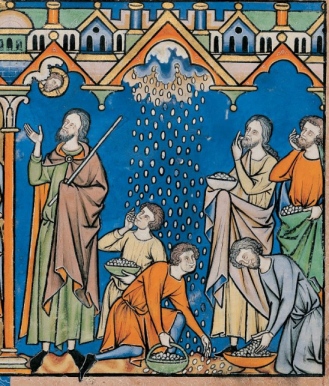
So to bring us up to the text for this morning from the Gospel, this is why the disciples are so perplexed by Jesus asking them to feed the five thousand men, plus women and children. Enough. They didn’t have enough. They wanted to have enough bread to feed them. What is the least we can get away with and still get by? That is how we by nature approach faith, if we approach it at all. What is the least that I can do in order to get into heaven? When we look at a problem, be it big or little, serious or not so serious, our solution, if you can call it that, is to assume that it is too great of a problem for God or for us. The sin is too great to be forgiven. The problems are too big. The disease is too bad. There just isn’t enough good to make it work.

But Jesus does not think in terms of enough. He’s not trying to get away with something. He does not sneak things by. He is recreating something. And what He is recreating is nothing less than a new heaven and a new earth. When Adam and Eve were in the Garden, God gave it to them to work it. He didn’t give it to them because it was work or die. He gave it to them so that they might share in His creative work of building and sustaining the world.

So here, in the feeding of the 5000, Jesus sets out to show His disciples, the world, and us that He is the one who feeds us. Man shall not live by bread alone, but by every Word which comes forth from the mouth of God. Every time you eat and are satisfied, that is a sign of Jesus’ continued presence and work in the world.

What’s more, every time you sit down and eat and rejoice at the table, your own table at home, it points you to the One Table. It points you to this table, here, where Christ feeds you with HIs own body and blood for the forgiveness of sins. Here, at this table, God’s mercy shines forth for you every day. The sins which cling to you fall away. Eternal life is your inheritance.

This day God holds a great gift up before you. It is the gift of faith. It is the gift of believing that God is God and you are not. It is the gift of learning how to trust in Him all the days of your life. Whether you live or die, you are the Lord’s. He opens His hand and satisfies the desires of every creature.

Come to the Table and set your unbelief and doubt aside. Come to the Table and believe that God will care for you and your family, body and soul. What’s more, God will carry you to His Home in heaven, where every tear will be wiped clean, every wrong will be set right, and where sin and death have no more dominion over you anymore. Come. It is more than enough. It is Jesus.

Believe it for Jesus’ sake. Amen.

John 6:1-15; Exodus 16

Solitude

As I’m starting to prepare for Laetare Sunday, I ran across the following quotation from John Chrysostom on John 6:3:

Crucifix at Lutheran Church in Potsdam, Germany

He went up onto the mountain because of the miracle he was going to do. The disciples alone ascended with him which implies that the people who stayed behind were at fault for not following. He went up to the mountain too as a lesson to us to retire from the tumult and confusion of the world. For solitude is appropriate for the study of wisdom. Jesus often went up alone onto a mountain in order to pray, even spending the night there. He did this in order to teach us that the one who will come most near to God must be free from all disturbance and must seek times and places away from all the confusion.1

Solitude is not something that comes naturally to me.  I long for it.  I desire it deeply.  But between church and family and other obligations, taking time to sit and meditate on God’s Word and study wisdom, well, that is low on my task list of things to do.

Why is that?  One would think that meditating on God’s Word would be high on the list of things for a pastor.  Aren’t I given to teach the Word of God to my people, in season and out of season?  Yes I am.

But there is something about life today that does not include solitude.  Maybe it’s the constant-connectedness of the interweb world.  I am certainly guilty of that.  Maybe it is the desire to cram STUFF into every nook and cranny of time.  I don’t know.  But one thing is for sure: there isn’t much solitude happening around here.

Is solitude important to you?  How do you guard your time so that it can happen?


-LL


1. Elowsky, J. C. (2006). John 1-10. Ancient Christian Commentary on Scripture NT 4a (210). Downers Grove, IL: InterVarsity Press.


Kept in Christ (Funeral Sermon for Hilma I. Maddern)

Todd A. Peperkorn, STM

Messiah Lutheran Church

Kenosha, Wisconsin

Funeral Service for Hilma I. Maddern

Psalm 121:8

March 21, 2011

HilmaMaddernSermon_01

TITLE: “Kept in Christ”

Family and friends of Hilma, both those who are here and those who are unable to be here, grace to you and peace form God our Father and from the Lord Jesus Christ. Our text for today is from the Gospel Lesson just read from Psalm 121 verse 8, The Lord will keep, your going out and your coming in from this time forth and forevermore.

Hilma Irene Maddern nee Waldros was born on October 7, 1922 and was baptized on November 7 of that same year. She was married at the tender age of sixteen on November 24, 1938 to her dear husband, Clayton. They are blessed with four children. Hilma was confirmed in the at Zion Lutheran church in what is now Ironwood, Wisconsin on March 28, 1937. She died in Christ on March 17 in the year of our Lord 2011, where she awaits the resurrection of all flesh. Blessed are the dead who die in this Lord from this time forth and even forevermore.

It is nearly impossible to evaluate the life of someone eighty eight years old, who was married at sixteen, and lived to see sixty eight years of married life. They raised four children, one of whom, Marlayne, was her special child who suffered from Down’s Syndrome until her untimely death in 2006, just a few short weeks after her husband, Clayton, died in Christ as well.

How would one describe Hilma? I suppose there are lots of words we could use. Words like charismatic or dedicated. Cheerful or faithful. I think I would use the word motherly. I’m sure each of you have your own descriptions.

It is also important to recognize that her life was not all roses and knitting. Taking care of her family was work, as any family knows. She could get discouraged and frustrated, even angry sometimes. Hilma was certainly a sinner, as are we all.

So what made things make sense for her? How did she survive the good times and bad, the lifetime of experiences that make up her story? The answer lies in her Baptism. Eighty Eight years ago she was baptized into Christ. When that happened, everything changed for Hilma. She was adopted into another family, a family far more wondrous than anything here on earth.

We prayed in Psalm 121 about a journey. Originally the Psalm was a traveling song. It was a song that the children of Israel would sing when they were to begin a journey. The song tells the story of how the first thing the Israelites would do is lift up their eyes and see that the beginning and end of the journey was in God.

God is the one who would not leave her alone on these many travels. He does not sleep. He is her keeper. He is the one who kept her safe in so many trials and tribulations. Every step of her life, God was there. Beginning, middle and end.

I was blessed to speak communicate with Pastor LaPlant, who has served Hilma since she moved up to Minnesota several years ago. So I know that God was still with her, blessing her, giving Hilma His own Son’s body and blood for the forgiveness of sins. Pastor LaPlant told me, “Every time she heard the Gospel lesson she would respond, ‘Oh – that is beautiful.’” I can hear her saying it even now. The Gospel is beautiful.

And dear friends, Hilma is now reunited with our Lord, and with Clayton, with Marlayne, with her parents and brothers and sisters and everyone who has gone before us and died in the faith. And there will come a time when she will hear the voice of Her Savior again. He will say to her, “Come, dear sister and daughter, come and rise up.” And all of the dead in Christ will rise again. Perhaps Job put it best so long ago when he wrote,

For I know that my Redeemer lives, and at the last he will stand upon the earth. And after my skin has been thus destroyed, yet in my flesh I shall see God, whom I shall see for myself, and my eyes shall behold, and not another. My heart faints within me! Job 19:25–27

The day is coming, beloved, when Christ will come again. Until that time, we weep at losing Hilma. She has been our companion and friend and mother and grandmother for many years. But we weep with hope. Because Christ is risen from the dead, Hilma will rise as well. It is okay. Jesus Himself wept at the death of His friend, Lazarus. But weep with hope. Your weeping will come to an end. This world will be left behind. There will be joy and rest that only He can give us.

So rest well, Hilma. Rest until we are reunited again with Him in heaven. Rest well, until we rise again with you.

In the name of Jesus. Amen.